


Embracing Each Day as a Chance to Serve
Pranati Shah, DO, pursues her purpose by giving patients clarity and understanding
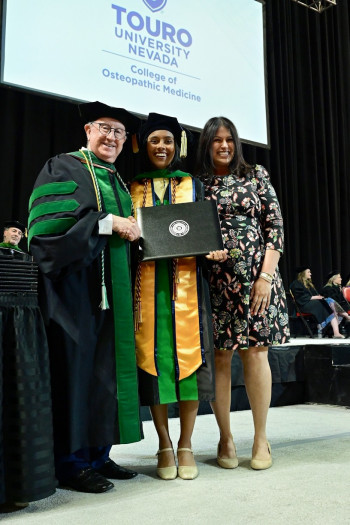 Resident physician Pranati Shah, DO, is the 2025 winner of the David Susser DO, MACOI Award, an honor that reflects the authenticity and determination with which she pursues internal medicine and oncology.
In her statement accepting that award, she shared that her goal as a physician is always “to help as many people as possible.” This idea is a powerful guiding force in her work at Loma Linda University in Loma Linda, California.
“Just yesterday,” she shared, “was my last day with my patients [for the week]. I told them a new team would be in tomorrow, and not to worry, because they know how to pick up where we left off.” One of the patients told her, compared to another hospital where he’d been, he couldn’t believe how much this team cared.
While the desire to give played a big role in Dr. Shah’s life, it didn’t immediately translate to the desire to become a physician. That came during her undergraduate education at UC Santa Barbara: she discovered an interest in biology, and at the same time, started volunteering at a local hospital. On top of that, at the same time, she had her first encounter with osteopathic medicine.
“A few of the hospitalists there had the letters DO after their name,” she said. “I didn't know what that meant. But then, I actually met an osteopathic physician—I worked with one who practiced OMM, Timothy T. Schultz, DO. I was concurrently taking a class in cell growth and oncogenesis and fell in love with how cells communicate.”
She had also started a minor in writing, with a focus on science communication. Using writing to break down complex topics and make them more accessible to the public was something she found fascinating. “Then,” she said, “I would go to work with Dr. Schultz, and I’d see this other side of medicine. He had such an easy, calm presence in the room with patients, and almost immediately provided relief. I was really lucky to be exposed to all of this at the same time when I was deciding what to do with my life.”
Dr. Shah took a gap year to apply to osteopathic medical schools. She knew she wanted to continue pursuing her interest in oncology, so she also started working at an anatomical pathology lab. Because it was a swing shift, during the day, she volunteered at St. Joseph Hospital Cancer Center in Orange, California, shadowing an oncologist. It was another setting where Dr. Shah saw empathy in action, through physicians who took pains to break down information for patients, countering their fears with truth and clarity.
Communicating to Build Patient Trust
While there are several ways to give and care for people without being in the role of physician, Dr. Shah said, “What drew me to this role in particular was the leadership,” she said, “and the trust I have the privilege of building with patients.”
That, she emphasized, is of utmost importance to her: “Patients trust you. As their primary care doctor, when they’re in the hospital, you are leading their team, you are answering all their questions—you're the one they trust, because you build that relationship.” Dr. Shah has found that, to that end, internal medicine and oncology have a strong symbiotic relationship. “The beauty of it,” she said, “is to be a good oncologist; you have to be a good internist. A big reason why being a good internal medicine doctor is so important is that you’re facilitating this person’s entire healthcare experience. In oncology [in particular], you might even see patients more than their primary care physician does.”
Over the last few years, and for the remainder of her residency, Dr. Shah has been building this foundation for herself to not just be an excellent oncologist in the future, but also to be the best internist possible.
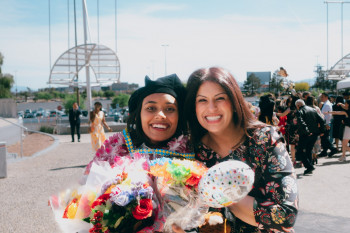 Her embrace of osteopathic medicine started with her time working under Dr. Schultz; it led Dr. Shah to completing medical school at Touro University Nevada College of Osteopathic Medicine. There, she said, “I got my foundational knowledge in medicine from fantastic osteopathic primary care physicians. They showed me empathy—what listening looks like, being there for patients, showing up.”
The impact went beyond that, she said: “There's a different class in which these physicians communicated with patients. At this point, especially with AI, medical knowledge is important and pivotal. However, the way we communicate that knowledge might be more important. I was lucky to have really good practicing osteopathic doctors at Touro who showed me what that communication looks like. If things are not communicated appropriately to others, it doesn’t matter if the information is right or wrong. If it’s not executed correctly, it falls flat.”
She counts these physicians among the many mentors who helped her along her path and emulated the kind of professional she wanted to be. She became a member of ACOI at the start of medical school, another experience that brought her invaluable mentorship. Specifically, Dr. Shah named Harpreet Tsui, DO, FACOI; her husband Kevin Tsui, DO; and Wolfgang Gilliar, DO, the Dean at Touro. She worked particularly closely with Dr. Harpreet Tsui as a fourth-year medical student, after meeting her during a rotation, and still stays in touch with her now. “She is very thorough and holistic with patients—about physical and mental health and socioeconomic factors alike,” said Dr. Shah. “I like having her guidance.”
Dr. Tsui, in turn, had this to say about Dr. Shah:
"For me, the thing about Pranati that stuck out from the first day I met her was her inquisitiveness. She had a drive to find out what the diagnosis was for a patient and the possible treatment plans. I was really intrigued by her ability to listen to patients so well and kind of piece apart what they would say to help figure out the diagnosis, which is really remarkable when you are a third-year medical student.
“And in the two years I had to mentor her, it was really obvious to me that she loved internal medicine and oncology in the way a detective loves solving mysteries. She's also so kind, so giving, so driven, and she, as my student, made me want to be a better attending. I just see the world ahead of her as her oyster, and I know that she is going to move mountains and inspire generations of other women behind her to do so much more than they dream possible if they put their mind to it."
Understanding Patients’ Needs, from the Global to the Everyday
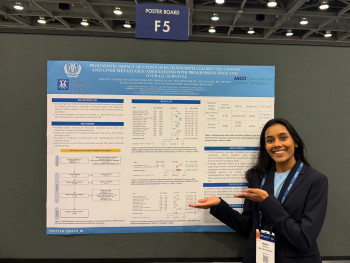 This brings Dr. Shah back to her intention of “helping as many people as possible.” It’s even a motto she uses to start off call days. “As senior resident,” she said, “I'm the team leader. The tone and vibe I carry will resonate with everything else. Setting a good example is important. I stole [that motto] from one of my attendings at Riverside University Hospital, Daniel Kim, MD. He would always do that on call days. I thought it was an amazing way to motivate.”
Dr. Shah’s additional pursuits demonstrate how serious she is about this ethos. She volunteers regularly with the organizations Health4TheWorld, which provides medical humanitarian aid to underresourced countries; and Share a Smile USA, which focuses on improving the lives of rural communities in India through education, women’s empowerment, and healthcare. With Share a Smile, Dr. Shah primarily engaged in empowering women through financial independence.
Health4The World has been an important avenue for Dr. Shah to use education and academic medicine for a bigger purpose. Through that work, she said, “You realize it’s not a lack of medical knowledge—there smart people all over the world—a lot of problems are resource-driven. In Cameroon, for example, the hospital had an OB-GYN, but they didn’t have light! They were doing deliveries in the dark. We were able to get solar-powered light panels for them. That already improves outcomes. You don’t realize what the limitations are of a person or community or country until you just talk to them or just listen. That tenet of patient-physician interaction extends to the entire world.”
What Dr. Shah has learned about communication, trust, and understanding in this context has proven to be foundational as she continues forward in oncology. “It’s a huge privilege to be part of someone’s journey when they get a diagnosis of cancer,” she said. “It's a huge responsibility. A lot of oncology care is end of life care as well. There's the optimistic side where there’s so much new science—but not every day in medicine is going to feel heroic. That's something I'm learning as I go further in my career.” Instead, she said, “It's about doing the little things—what’s right for the patient, what’s aligned with their goals in life. The little wins—for example, my patient wants to see the sun, so let's give them a way to get outside and feel fresh air. Or what can I do to help them stop being nauseous and enjoy a dinner out?” Respecting those needs, she said, goes a long way to continue to build and hold that sense of trust. “Being part of that decision-making process,” she said, “is a privilege.”