

Voices Across ACOI: Kesha Amin, OMS-IV
by ACOI
December 3, 2025
Finding Purpose through Problem-Solving and Providing Care
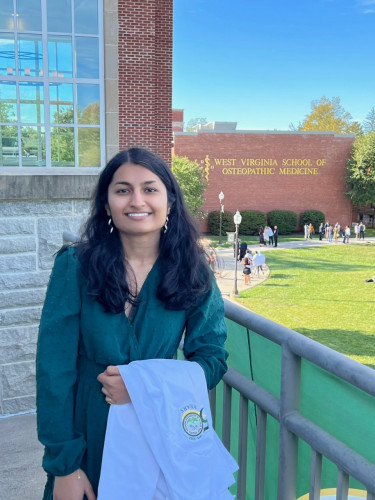 One of the events at the Annual Convention that speaks powerfully to the ACOI mission is the Student Poster Contest—as a means of sharing research, exploring quality care, creating meaningful connections, and even bringing new members into the ACOI community. One of this year's student poster winners, Kesha Amin (OMS-IV, West Virginia School of Osteopathic Medicine), as well as her winning poster, are shining examples of how a broad, whole-patient approach can lead to surprising insights and improved care.
The case, “Hypermobility Spectrum Digestive Disorder (HSDD): An Underdiagnosed Cause of Chronic GI Symptoms,” came about in a surprising way. “I stumbled upon the patient that the case was based on at my GI rotation,” Student Doctor Amin said. During that rotation, which was at a private practice in South Plainfield, New Jersey, with Dr. Srinivas Channapragada, they saw several patients with hypermobility spectrum disorders. “In a GI practice, you wouldn’t imagine people would be screening for that, because it’s more musculoskeletal and rheumatological,” she said. “We noticed, thanks to our patient that my poster was based on, there is actually a correlation between hypermobility spectrum disorders and chronic GI complaints.”
Using that patient as a model, the clinic began screening other patients for hypermobility, finding several hypermobile patients with a higher propensity for these multi-systemic complaints. As they began conducting more regular screenings, they noticed an even stronger link. Specifically, Student Doctor Amin said, “We found out that the correlation between them is due to laxity of connective tissues causing a concurrent syndrome called mast cell activation syndrome (MCAS). In MCAS, too many mast cells are activated, because the tissues are so lax because they’re so hypermobile. These mast cells produce a lot of histamine, and from that, they have a lot of symptoms going on. Not just GI, but also symptoms such as dizziness, brain fog, and anxiety. We actually used a trial of H1 and H2 blockers to mediate that histamine release. And we noticed that a lot of our patients, including the one I did my case on, had a dramatic improvement in their symptoms.”
Beyond the case's novel nature and impressive outcomes, it was notable that being in osteopathic medicine provided a foundation for noticing this connection. “Before seeing it in practice,” she shared, “I had never heard of it. I knew about hypermobility just because I go to an osteopathic DO school, and we screen for that when we do manipulative techniques.” Even with that basis of knowledge, Student Doctor Amin's preceptor only found out about it after doing more research himself. What they found was how common—and underdiagnosed—hypermobility spectrum disorders truly are.
“A lot of these patients with these symptoms get misdiagnosed. Either [with] chronic fatigue, or IBS is a big one,” she said. Given this newfound awareness, the team wanted to use the poster to raise more awareness and encourage screening. Ultimately, they were able to conduct more evaluations at the clinic and create a term for the condition: hypermobility spectrum digestive disorder (HSDD). "That’s the distinct GI phenotype of this condition,” said Student Doctor Amin. “Because this condition, we’ve realized, can cause multiple other conditions. Personally,” she added, “I’m going to look into more of the other [related] conditions, get more information about it, and see if in my other rotations, I come across anyone who has these symptoms. Maybe I could bring information to light about this condition.”
Wholeheartedly Embracing a Whole-Person Approach
This drive to understand these different facets highlights how well osteopathic medicine fits Student Doctor Amin. She was drawn to it, and medicine as a whole, because of both its practical problem-solving and caring, patient-centered sides.
Growing up, she had always been interested in the sciences; in high school, she volunteered in a New Jersey hospital as a patient aide. It was a formative experience: “Seeing how the patients and providers interacted with one another, how much mutual respect they had, inspired me to go into medicine and take on a bigger role,” she said. “I realized medicine isn’t just prescribing medication. It’s taking care of the patient and emphasizing the whole-body approach.”
Being at an osteopathic medical school has been a natural continuation of that interest. Both of her parents are first-generation immigrants to the US, and she is the first person in her family to go into medicine, so it was only when applying to medical school that she found out about the osteopathic approach. Internal medicine arose as a potential path as Student Doctor Amin gained experience in the clinical setting. She volunteered as a medical assistant for two different outpatient internal medicine clinics; “From there, I got more experience in internal medicine, and how it deals with a variety of conditions and systems,” she said. “It’s really cerebral, like solving a puzzle.” Beyond that, it gave her more opportunities to form patient relationships. “[Because] a lot of internal medicine is chronic conditions,” Student Doctor Amin said, “you see a lot of the same patients every few weeks or months, and I love that part of it.”
Becoming a member of ACOI came afterward, as part of entering her poster into the contest at the Annual Convention. At WVSOM, many students are heavily involved in ACOI, she said; an email about the student poster contest was circulated to the students around the same time she came across the HSDD case. With that excellent timing, Student Doctor Amin entered the contest—which, while it wasn’t her first ever, was her first time at a national contest or convention. “It was definitely a great honor to be able to present my work there and be recognized for it,” she said. Meeting other osteopathic medical students and faculty was a specific highlight: “It was a great place, even though it was my first time, to be able to connect with all these people, that I never would have had time to talk to [otherwise],” she said.
Connecting through Creativity and Curiosity
Student Doctor Amin’s penchant for both problem-solving and relationship-building has guided her to use other skills to help others, including by volunteering with the Turner Syndrome Foundation. She began working with them just before medical school, wanting to use her time and skills to serve locally and make a difference in the medical community. Now, she gives her time through graphic design, creating outreach-focused and awareness-raising pieces for the organization.
Currently, Student Doctor Amin is in an internal medicine rotation at the Central Jersey Internal Medicine Associates office in Somerset, New Jersey. As far as her post-medical school and residency aspirations, she is interviewing for internal medicine residency, with an interest in pursuing nephrology fellowship awards. “I find chronic kidney disease and different acute renal conditions very fascinating,” she said. “My grandfather had end-stage renal disease, so that’s also why I’m drawn toward nephrology." She is currently interviewing for nephrology fellowships to follow her internal medicine residency. Ultimately, she’d also love to return to her hometown to practice. “I really have loved my time in West Virginia,” she said, “and I did want to bring back whatever I learned to my home state. It’s also where my family and friends are—that support is really important to me.” Understanding those connections has created a well-rounded start to her career, and it is clear it will continue to lead her on a meaningful trajectory in medicine.