

Voices Across ACOI: Adrian Renaldi, DO, FACOI
by ACOI
January 28, 2026
A Path Transformed by Kindness
Adrian Renaldi, DO, FACOI, serves by giving back what he’s received
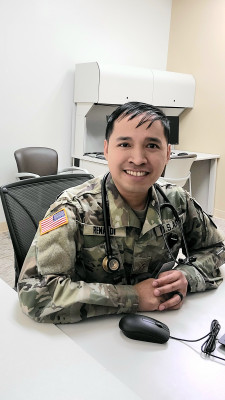 Gratitude, it’s often said, is a source of joy. Adrian Renaldi, DO, FACOI, is an internal medicine physician who lives out this idea. Based in New Mexico, where he lives with his wife, Rosanna, and children, his work includes chronic disease management and treating HIV, hepatitis C, and substance use disorder. He has also been part of the US Military for 15 years and is currently mobilized with the Army Reserve in Fort Riley, Kansas. His military service is a major part of what made his career in medicine possible; while many physicians join the military, Dr. Renaldi’s experience is unique in that he was naturalized while serving. Born in Jakarta, Indonesia, he grew up in East Java and moved to the US when he was 14 years old.
“When I first came here,” he said, “I didn’t speak English at all. And at the time, my school didn’t have ESL classes.” He attended Marist High School in Bayonne, New Jersey, and while the lack of ESL was a challenge, it was also helpful: it pushed him to learn English in other ways, so he could communicate with the people around him. "It took about six months or so to be comfortable speaking and listening to other people,” he said. What helped more than anything, he added, was the kindness of his classmates and teachers.
“That was probably the big thing I noticed when I first moved here,” he said. “People are kind. A lot of the teachers put in extra effort so I could catch up. And not just teachers—even friends. A lot of people were curious about Indonesia and even asked how to say things in Indonesian.” When he joined the soccer team at Marist, his teammates were eager to help him, too. “They understood that my English at the time was limited,” he said, “and spoke slowly in the beginning." This being before the time of Google Translate, that was extraordinarily helpful and meaningful.
These experiences were foundational for Dr. Renaldi. The kindness he encountered, relationships he built, and gratitude for both have been the fuel for his journey as a physician.
A Relationship-Oriented Path into Medicine
Dr. Renaldi’s medical career technically began when he became a pre-med student in college. However, his first encounter with osteopathic medicine was before that: his primary care doctor in New Jersey, Dr. Howard Levine, was a DO. Dr. Levine also regularly had students working with him on rotations.
“I’d always see medical students going in and out—I didn’t think much of it until I got to college. I wanted to go to medical school at the time, and was studying biology,” he said. “I asked if I could shadow him. He said yes—he took me in and taught me a few things about osteopathic medicine while I was still pre-med.” The experience was positive enough that it led Dr. Renaldi to apply to osteopathic medical schools.
He attended West Virginia School of Osteopathic Medicine (WVSOM), choosing it after a visit that showed Dr. Renaldi that they cared for students as whole people, in a way that reflected the philosophy of osteopathic medicine. At WVSOM, he realized his passion for working with patients in underserved communities. “For a long time,” he said, “I thought I’d go back to New Jersey. But I ended up loving rural medicine and serving the underserved. When I was in rotations, I rotated through not just academic, but also community clinics. And I learned a lot about rural medicine. When I got to residency, I chose one that focused on that.”
Dr. Renaldi completed his residency in Tahlequah, Oklahoma, at the Osteopathic Medical Education Consortium of Oklahoma (OMECO), part of Northeastern Health System. During residency, he joined ACOI, inspired by his attendings involved with ACOI as members and Fellows—including his residency program director, Thomas Schneider, DO, FACOI. Because of that, he said, “I wanted to get more involved with the ACOI and become a Fellow. It’s a great organization. I share a lot of their mission and vision, and I’ve met a lot of kind people in the ACOI.”
The clinic gave Dr. Renaldi another route to fulfilling that mission. There, he worked closely with the Cherokee Nation, which showed him the level of need that exists in many parts of the U.S. “That’s when I felt that, when I finished residency, I wanted to work within those underserved populations," he said. “I wanted to get down and dirty with the people who no one else wants to see.”
His first job in New Mexico was at a rural clinic in Socorro, Presbyterian Medical Services. There, he began learning about and treating conditions like hepatitis C, HIV, and substance use disorder. He is still on staff with that company, now at the Rio Rancho clinic, which is a federally qualified health center that takes patients who don’t have insurance or are underinsured—some of whom are part of the area’s homeless population. To Dr. Renaldi, this is all part of his passion, and he maintains this focus in addition to providing preventative care.
An In-Depth Understanding of Need
Dr. Renaldi’s work with underserved communities, in many ways, reflects what he encountered growing up in Indonesia. The needs are strikingly similar, he said. The main challenge he remembers from Indonesia was that of access.
“We didn’t always have the available care nearby,” he shared. “Personally, my father passed away from a stroke when he was in Indonesia. For him to get to a stroke center—maybe the nearest was about 50 miles. But because of the lack of infrastructure and road access, that would be three or four hours’ distance.
“I see that similarly in these areas, too. In New Mexico, for example, when I was in Socorro, some of my patients traveled close to two hours just to see the nearest primary care provider,” he said. “It was the same thing when I was in Oklahoma, too. And it’s not just that—even if you are able to see a primary care provider, the next problem people face is availability of specialty care.”
Pharmacies present a similar challenge, he said: “In Socorro, there used to be three pharmacies in town. Now they’re down to just one. Sometimes that pharmacy would run out of medication, and people just aren’t able to get it, because they don’t have transportation to get to other places. It’s similar to Indonesia—sometimes, even if you are able to see a primary care provider, to get that medication is another journey.” Vaccines present another point of similarity. In Indonesia, he said, “The polio vaccine was at one point hard to get. Some people had to travel far to get that vaccine, even though they had a primary care provider. I realized, when I went to West Virginia, I’d [already] seen some of these stories and issues that people in rural America and in underserved communities are facing. It was kind of shocking to me when I learned that.”
Staying Inspired to Support Others’ Growth
Having this perspective has strengthened Dr. Renaldi’s sense of purpose. What motivates him, he said, is “Knowing that my patients feel better and can accomplish what they would like to accomplish. And what that means varies from person to person. Because, to some people—I have patients at the ends of their lives and sometimes what they would like to accomplish is, ‘I just want to see my grandson graduate high school.’ Being a part of that is an honor. I think that’s part of the reason why I like preventive medicine—it’s [a way to] help them accomplish what they would like to accomplish in their lives as much as we can.”
Pursuing this purpose within ACOI, in addition to becoming a Fellow—which he accomplished in October 2025—has meant getting more deeply involved in the Committee on Ethnically and Racially Underrepresented Populations in Medicine. After joining this past year, he hopes to contribute by working with residents and students on the issues they encounter as part of underrepresented groups.
Supporting medical students is an especially big motivator for Dr. Renaldi, especially in light of the guidance he received as a student. “I’m hoping to be able to inspire them to get into osteopathic medicine, or medicine in general,” he said. “I feel like lately, there's been a lot of bad rap about medicine. And there are more challenges to get to medical school, to get into residency, and become a doctor. I sometimes see that—in my clinic back in New Mexico, and even when I was in Oklahoma, I would see people say, ‘I want to be a doctor, but can’t.’ I wish I could reach some of these folks, so they could realize, even if there are challenges ahead of them, there are people who will help them get through those challenges. It could be me; it could be someone else—but that’s something I hope to accomplish in the future.”