

Physician, Heal Thyself…Or Ask for Help
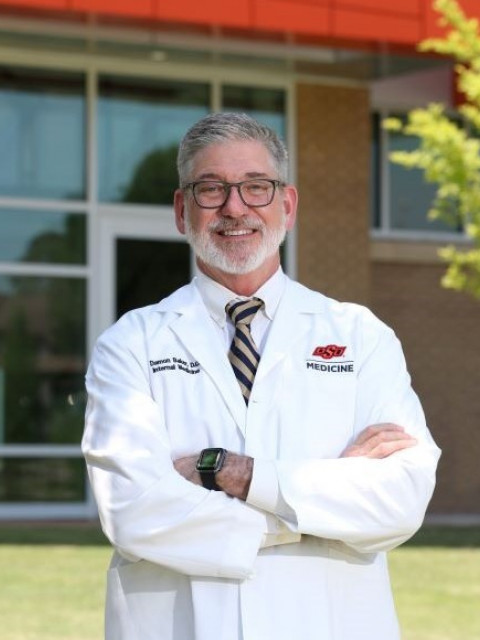
by Damon L. Baker, DO, MACOI
May 4, 2026
I want to tell you a story about a close colleague and dear friend of mine—an osteopathic internal medicine physician and educator, and without question the most compassionate doctor I know. No one advocates harder for her patients. No one worries more about our residents. If caring were an Olympic sport, she’d have multiple gold medals and still be apologizing for not doing more.
I often describe her as a self-made woman. She dropped out of high school, worked her way through college at a dry cleaners, and entered osteopathic medical school at 38 years old. She became class president, matched into a very competitive internal medicine residency, served as chief resident, and was named Outstanding Intern of the Year—and then, just to make the rest of us feel inadequate, Outstanding Resident of the Year in her third year. She is now the Chief of Staff at our hospital.
As you can see, a classic underachiever.
She recently turned 60 and finally decided she should probably have a primary care doctor—someone other than her gynecologist. (I had only been suggesting this for years.) So she scheduled an appointment with one of our outpatient physicians. During that visit, her doctor noted a systolic murmur and ordered an echocardiogram.
This was not entirely new information.
About a year and a half earlier, her gynecologist listened to her heart and said, “Sister, you’ve got a murmur. You need an echo.” She later admitted that her internal response was, “Just give me my estrogen.” She also confessed—without shame—that she never even listened to her own heart to check.
You know. Physician, heal thyself.
About a week after her primary care visit, she was in our internal medicine clinic staffing residents. That day happened to be the day of her echocardiogram. The cardiology offices are one floor above us. After checking in, she saw one of the cardiology faculty and casually asked if he’d be reading her echo. He said he’d “pop in for a look.”
Several minutes into the exam, he entered the room. The echo tech asked him to look at something on the screen. There was a pause. Then he said a few words I can’t repeat here, because this is a family publication.
She asked what he was seeing.
“Severe aortic stenosis.”
The report later confirmed it: severe aortic stenosis due to a congenital aortic valve. She had been a little nervous before the test. Now she was stunned—and terrified. Her mind raced: How could this be? I crushed a Max VO₂ test. I walked the Camino de Santiago.
Like any rational physician, she immediately consulted multiple trusted colleagues, collecting opinions and guidance. After speaking with the Chief of Thoracic Surgery at our institution, she decided to have her surgery at our partner hospital.
A surgery date was set: January 5—one month away.
She told me she spent most of that month in denial. Even now she barely remembers what the surgeon said. One thought drowned out all others: They are going to saw my chest open. She worried about going through this alone. She worried about dying before surgery. And she was especially terrified of waking up intubated.
So she did what any sensible person facing open-heart surgery would do. She went to her favorite spa in Sedona.
Before leaving, she wrote letters to her closest friends, telling them how much they meant to her—just in case she didn’t come back.
When she returned home the day before surgery, she didn’t sleep that night. She was scared, anxious, and overwhelmed. Her best friend picked her up just before 5 a.m. She checked in at 5:30 a.m. In pre-op, the anesthesiologist stopped by to talk and perform a nerve block.
That was the last thing she remembered.
The next moment, she was being wheeled down a hallway. Her first thought: Have I had the surgery yet? Then immediately: Oh yes. My chest hurts.
She was intensely hot. There was a warming blanket on her, and she fought to pull it off. And then she realized her worst fear had come true: she was waking up intubated. She felt like she couldn’t breathe. She gagged on the tube.
As she told me this, her voice cracked. The memory still had teeth.
I asked her when she first believed she was going to survive.
She said it was the next day, when she stood up and walked. Physical therapy took her down the hallway of the CV ICU. She looked into the other rooms. One patient was on ECMO.
That was the moment she stopped thinking about dying.
She also realized something else. She wasn’t alone. Her room was full of people who loved her. Her post-discharge care schedule was already mapped out. Meals, rides, check-ins—all handled. She wasn’t just supported; she was surrounded.
She had a family. The family she chose.
Today, she is fully recovered and back at work, seeing patients, training residents, and teaching students.
Before we hung up, I asked her two questions: What did you learn? And how did this change you as a physician?
Her answers were simple:
- Don’t be your own doctor.
- Take care of yourself.
- Your health is the only thing you truly have.
And if it’s possible, she now has even more empathy for her patients, especially when it comes to adherence. Especially when someone feels better and decides they don’t need the medication anymore.
Physician, heal thyself.
Until next time,
Damon
P.S. Registration for the Annual Convention in Palm Springs is now open—please be sure to register. Nominations for the ACOI Fellowship are open through June 12. If you're board certified and have been a member of ACOI for two years, I recommend you submit a nomination.