

Voices Across ACOI: Kardie Tobb, DO, FACOI
by ACOI
June 1, 2026
Rethinking What's Possible in Medicine and Advocacy
Kardie Tobb, DO, FACOI, brings a positive, forward-thinking mindset to her work in cardiology and internal medicine
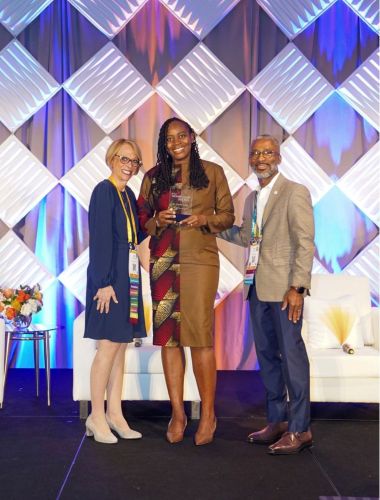 Kardie Tobb, DO, FACOI, has been busy lately, and not only with her career at Cone Health in Greensboro, North Carolina, where she is on staff as a cardiologist and serves as both Clinical Integration Officer for its Center for Health Equity and Medical Director of its Women’s Heart Health/Cardio-Obstetrics Clinic. Over the past few months, she’s also been published multiple times; featured on local news station WFMY News 2 in Greensboro, North Carolina; and received the RISE 2026 Health Care Hero Award. This is all on top of being inducted as a Fellow at the most recent Annual Convention and becoming a consistent contributing member of the ACOI Committee on Ethnically and Racially Underrepresented Populations in Medicine.
About her induction, Dr. Tobb shared, “For me, it’s about being a part of the community—a community I chose based on its merits of support, empowerment, education, and advocacy, and also for opportunities to be of service to others. Becoming a Fellow of the ACOI is not only exposing you to more people you can learn from but really opening that door to becoming part of something bigger as a physician.”
Dr. Tobb’s entire path into osteopathic internal medicine is rooted in this perspective. It was through a great deal of support, and her own determination to be of service, that she created that path.
“Frankly, medicine as a career was something that, from childhood, was encouraged,” she said. “I’m from a family of all girls. One of the things my dad used to say to us was, we were not limited in things that we could do.” Her father in particular was someone who saw Dr. Tobb’s caring nature and was sure she could become a doctor.
While completing her undergraduate education at West Chester University in West Chester, Pennsylvania, she began to fully own that desire to be a physician and sought opportunities to volunteer in medicine. “That’s when I understood the value I could bring as a physician,” she said. “You can say as a kid, ‘I want to be a doctor’; that was where I found the ‘why,’ and the difference you can make.” Shadowing for the first time, and deeply enjoying it, made a huge difference. “Those physicians,” Dr. Tobb said, “made me think, ‘This is something I could do.’” Their encouragement helped her envision herself in a career like theirs, and significantly, she was never told she couldn’t do it.
That kind of experience was integral to Dr. Tobb discovering osteopathic medicine as well, which she did while shadowing Carl R. Pullen, DO, at Philadelphia College of Osteopathic Medicine (PCOM).
“When I was thinking about transitioning to medical school, he took me under his wing,” she said. “He really helped me—at that time, I had never really thought about DO versus MD. Because he was a DO, he helped me see the possibilities, not limitations. Even though my first volunteer work was at the hospital, I credit my strong interest in attending PCOM to him.”
Discovering a Resonant Career Path
While at PCOM, Dr. Tobb initially considered going into pediatric medicine. But, she said, “After I got into rotations, I realized pediatrics was not for me.” She then started seriously looking into obstetrics. “I was on the OB wagon,” she said, “when I rotated with another DO.” That physician was David J. Addley, DO, a cardiologist and ACOI member.
That experience turned out to be formative. “Working with him,” said Dr. Tobb, “what I liked was the fact that he could go and see the patients in the morning, round, and then do clinic visits. And then the next day, he could just do echocardiograms, and the next day he could do nuclear imaging. It was the diversity of what you could do—the different ways to be able to follow someone’s health. You build that relationship with a patient.”
It is a decision that has guided her toward what she is most passionate about and illuminated the myriad ways to serve not only as a physician, but also as an advocate. A few powerful examples are Dr. Tobb’s research and publications: recently, she published an article in the American College of Cardiology (ACC) magazine Cardiology on racial bias and microaggressions; she also was part of the team that published the study “Hypertension in Women Across the Life Cycle: Unique Aspects and Challenges.”
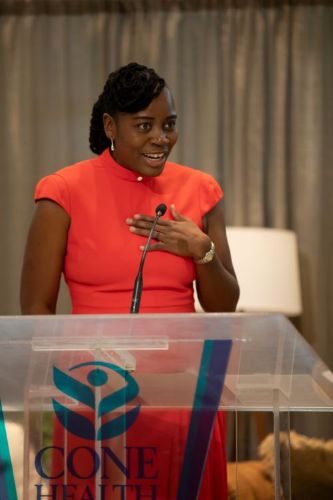
Another example is the award she received from RISE. “I was nominated for that because of the work I lead here at Cone Health, in terms of our work on social drivers of health and women's health initiatives.” Recounting the story, she laughed, saying, “A very close friend and colleague nominated me, and when I found out I was one of five finalists, I was grateful, because all the finalists were doing amazing, life-changing work as well.” Her colleagues' collaboration was also vital, in Dr. Tobb’s eyes, to her being considered in the first place: “I won not because of me, but because of the team I work with, which makes me so grateful,” she said.
Dr. Tobb said her ventures into health advocacy are important to her both clinically and personally. “I have always been passionate about it,” she said. “It’s important to me that people are treated fairly and offered resources that are tailored to them in different ways.” It’s especially meaningful to her when it comes to women: seeing the opportunities she has had that other women in her family didn’t has given her even more of a drive toward this kind of work, and helped her begin to view herself not just as a caregiver but as a leader. To her, leadership means several things, from doing care differently at Cone Health, to looking at women’s cardiovascular health on a deeper level, to exploring cardio-obstetrics (cardio OB). And, of course, making her voice heard in the realm of equity and supporting the next generation of physicians.
“There are things we experience as women physicians that our male counterparts may not experience, or may not resonate with them,” she said. “That's why I create that advocacy for how it is for us as physicians—and for us as DOs, and for us as women,” she said. To that end she has found a great deal of support through groups like the Women in Preventive Cardiology Working Group—part of the American Society of Preventive Cardiology—where she gets to engage in mentorship and pass along what she’s learned to other young women and peers.
Passing Along Encouragement and Support
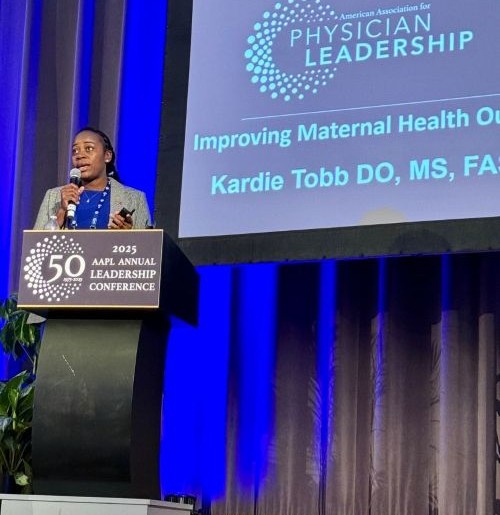 This focus has been a major part of Dr. Tobb’s involvement with ACOI as well; being part of the Committee on Ethnically and Racially Underrepresented Populations in Medicine gives her a similar source of connection and support. By the time she found out about the committee, she had already started working on health equity measures within her health system and other organizations. “I thought, this is right up my alley—something I can relate to and have experience with,” she said. “I applied, and a month or two later I saw someone from ACOI looked at my LinkedIn profile, and thought, ‘Maybe I’m going to get in.’” She did, of course: now that she’s involved, she said, “I couldn’t be happier with the group.”
Being a committee member has had benefits beyond getting to engage with its subject matter and connect with other members: it has strengthened her connection to ACOI as a whole. “For a long time,” Dr. Tobb said, “I was just paying my membership dues and moving on, reading emails every now and then. But now I feel invested as a physician. I feel like this is for us. I'm not just a passerby paying dues. I’m part of this big thing—and how can I help make it better? Once you get involved and engaged, your mindset shifts. You realize how much this organization does for its members.”
Even in these major moments, Dr. Tobb is clear-eyed about the small and seemingly minor steps that have constituted all of it. “The truth of the matter is,” she said, “if I were to talk to my first-year medical school self, I would say, ‘You weren't prepared, but you stepped up.’ And I would do it all over again.
“I tell medical students,” she continued, “when you’re given the smallest task, give it your best and do your best work. It's the small tasks that take you to better opportunities. That's where I started—just doing my part and helping others with what they needed and doing it well.”
What else keeps her going and moving toward whatever is next? She shared a Nelson Mandela quote, straightforward yet inspiring: “It always seems impossible until it’s done.”
“That is my North Star,” Dr. Tobb said. “Because sometimes we think of things that are outside the box and haven’t been done—and you always have to ask, ‘How can it be done? Who do I need?’ You need a team. No one is successful by themselves. If you have a team who can help, you are successful. You always have to think, it’s not just ‘I did it,’ but ‘we did it.’ And I really am guided by that."
Apply to Become an ACOI Fellow
The ACOI Fellowship is an incredible opportunity to demonstrate your commitment to the osteopathic internal medicine community. If you are interested in taking on a new leadership role and taking the next step in your career, apply to the ACOI Fellowship! The deadline for nominations is June 12, 2026—learn more and apply today.