


Outstanding Resident of the Year: A Conversation with Danielle C. Thor, DO, MAUB
by ACOI
August 24, 2026
ACOI is thrilled to recognize Danielle Thor, DO, MAUB, who was selected as the 2026 Outstanding Resident of the Year. This award, presented in collaboration with the American Osteopathic Foundation (AOF), recognizes an osteopathic medical resident who exemplifies altruism, while demonstrating clinical excellence, leadership, and dedication to osteopathic, patient-centered care; and whose commitment to osteopathic principles distinguishes them within their program and the profession.
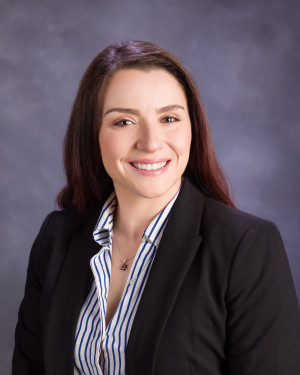 Dr. Thor graduated from Touro College of Osteopathic Medicine – Harlem in 2023. Her residency program, which she completed this year, was at Jefferson Health New Jersey. She is currently a Bone Marrow Transplant (BMT)/Cellular Therapy Fellow at Fox Chase Cancer Center, part of Temple University Hospital. ACOI recently spoke with Dr. Thor about her background in osteopathic medicine and her goals for the future.
Congratulations on this honor! What was your reaction to finding out you were selected? What does this mean to you?
It was definitely a surprise! A lot of excitement, and a sense of gratitude as well. Residency is a very tough pursuit—to be acknowledged for those accomplishments while keeping your head above water is gratifying.
What inspired you to pursue medicine, and internal medicine in particular?
I have wanted to go into medicine since I was a really little kid. One of my earliest memories is watching surgeries on TV with my dad when I was four or five years old. I remember my mom walking in, and looking at us, and she was about to ask why he was letting me do that. But then she thought, "Let’s see where this goes." And now, here we are.
I now have a background in hematology and oncology, which is internal medicine heavy. In general, I liked the idea of providing definitive care—receiving folks as they are, managing complex conditions, pulling together all the appropriate players to reach a conclusion for the patient. I worked in EMS for a while before medical school, and it stopped being fulfilling because it was just stabilizing patients and sending them on to someone else. With internal medicine, I became the "someone else."
That said, there's a lot of crossover between emergency response and internal medicine. In internal medicine, there are still emergencies. It gave me that calmness under pressure I needed to respond in that environment—especially in residency, and the ICU. There was an easy transition. EMS gave me the foundation of knowing how to approach patients, and the basic clinical skills I’ve relied upon for my entire career.
What have your residency and fellowship experiences been like? What have you learned through those experiences?
I'm in a unique situation in that I just finished residency about two months ago, and I started a bone marrow transplant fellowship. I ended up at Fox Chase Cancer Center because I worked with them before medical school when I pivoted from EMS to oncology. I fell into clinical research there and ended up loving it. One of the most rewarding parts was working with my fellow residents. We came from all different walks of life, all different interests. It showed me that, especially in internal medicine, there are so many directions you can take. We all came together and had this strong sense of camaraderie.
You’ve been involved in several different initiatives—to name just a few, you're one of Jefferson Health's Pride Care Affirming Clinicians, and were on the health system's Housestaff Quality and Safety Leadership Council. What have these commitments meant to you?
Residency gave me a couple of unique opportunities to participate in committees that were a bridge between residency and attendingship. The Leadership Council is the best example. It’s the main quality improvement council for the entire health system. This was made up of attendings and housestaff. That was rewarding because it opened my eyes to the fact that, even though I'm in training, I'm still a physician. There are times in training where you can lose sight of the eventual goal, that you are going to be an attending and practice—you're still going to call these people your colleagues.
I was also one of a handful of residents to become a Pride Care Affirming Clinician, and the only one in internal medicine. The concept of being out and open and identifiable was the most important part of that—it comes with risk. It's implied that, if you’re going out of your way to treat the queer community, you’re part of it. It was no secret that I was; I took that opportunity because it was important to me. I think visibility is the most important part. It's about being a presence that patients can rely on. Patients would actually seek me out in my internal medicine resident clinic, because they knew I could provide that service.
What are your future aspirations in medicine?
Right now, I am in a BMT fellowship, and I am still working some per diem shifts as an attending in internal medicine through Jefferson Health. This year, the goal is to match into a hematology-oncology fellowship. The ultimate goal is to work in transplants and cellular therapy, treating blood cancers, and eventually expand to autoimmune diseases, solid tumors—things like that. That's all the more reason for general hematology-oncology training.
What are some of your personal interests outside of medicine?
My undergraduate degree was in kinesiology; I’m a bit of a gym rat, and a power lifter, though not a competitor. I do like to travel, and I have Mitch, my cat, as well. The rest is to be determined; I'm told that you relearn who you are when you finish residency!
If you could give advice to a graduating medical student starting residency, what would you tell them?
I would say that no matter what your interests are, take the first six months of your residency to learn how to be a doctor. You've been training your whole life for this. Lean into it and get good at what you do. Don't get overwhelmed by expectations—just get good at the foundation, and everything else will come thereafter.